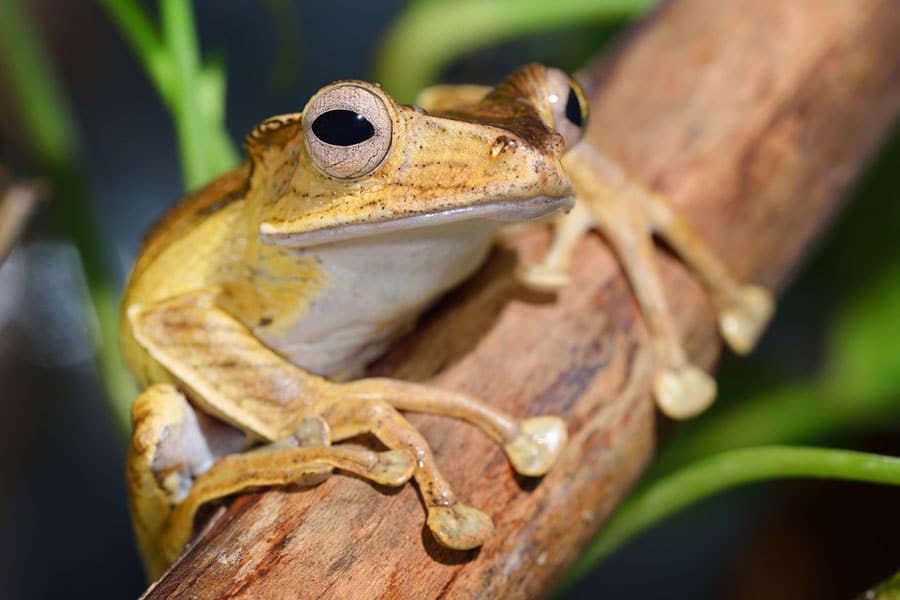
About: Borneo Eared frogs, also known as the file eared tree frog, are arboreal frogs found in the forests and wetlands of Borneo, Indonesia, and Malaysia. These frogs are normally considered a social species, and do best in groups of 3-6, as long as adequate space is provided. Borneo eared frogs tend to live up to 10 years in captivity, and can grow to be 3-4 inches.
Frogs can absorb liquid and moisture through their skin, so it is advised to avoid handling them if possible. If handling is required, be sure to wear gloves, or wash your hands before and after to avoid oils or harmful bacteria touching the frog.
Lighting: Borneo eared tree frogs are nocturnal, so a UVB light isn’t strictly required like it is with most reptiles and amphibians. However, UVB is highly recommended, and can provide many health benefits to a frog’s bone structure and overall health.
For heat, a small heat lamp may be necessary if your house is consistently cold. They enjoy an overall temperature of 75°F, with a cooler side of the tank around 65-70°F. You can make a heat gradient by placing the heat source on one side of the tank, allowing one side to be warm and the other to be cooler.
Tank: The minimum tank requirement for one adult Borneo eared frog is a 20 gallon high tank. Any more frogs will require a larger living space.
Because these frogs are arboreal, it is better to have a taller tank, rather than a longer one. This type of treefrog will thrive in a humidity of around 60-70%. A good way to help keep humidity high is to have a substrate (anything that’s used as ground cover or bedding) that holds moisture well, a mix of any reptile-safe soil, and coconut coir. Adding moss, like sphagnum or live moss, can help as well.
Feeding and Watering: Because borneo eared tree frogs require high humidity, you may need to mist the tank every day or every other day. To determine humidity, you can use a hydrometer, which measures the moisture in the air.
Frogs need a water dish large enough for them to soak in because they absorb water through their skin.
Borneo eared frogs can eat a variety of insects depending on their size. A good way to tell what size insect you need is to choose one that fits between the width of your frog’s eyes. Any gut loaded insect like crickets, fruit flies, or roaches will be a healthy choice. Whatever insect you choose to feed should be dusted in calcium powder, to help increase bone structure and prevent bone diseases.
Borneo Eared Tree Frog Supplies Checklist
- Tank
- Screen lid
- Lid clamps
- Foliage
- Water bowl
- Thermometer
- Hydrometer
- Light fixture
- Heat bulb
- UVB
- Mister
- Substrate
- Moss
- Tongs
- Critter keeper
- Calcium
Have More Questions? Call the Experts at Moby Dick Pet Store at (248) 673-2520