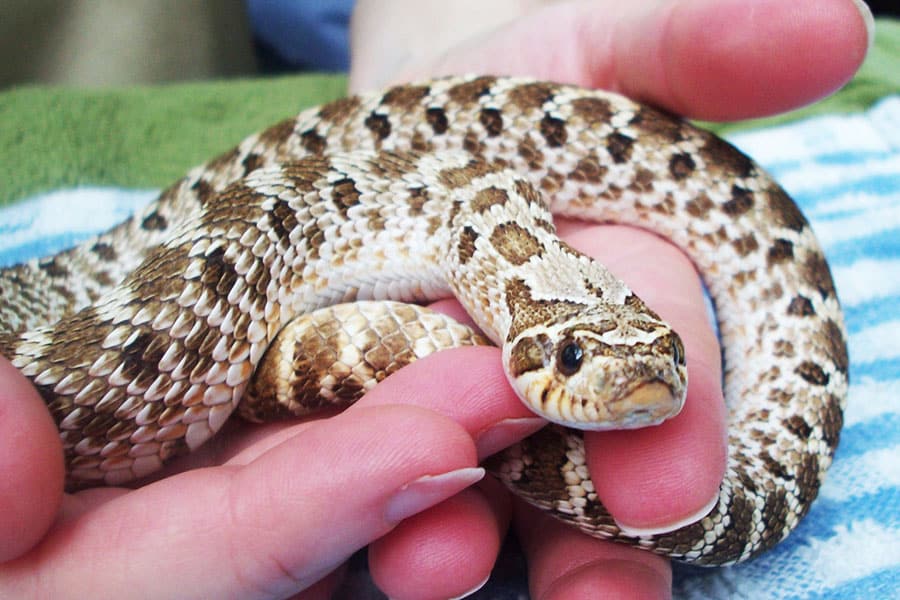
About: The hognose snake is a diurnal (active during the day) carnivore native to North America. Hognose snakes have a little ‘shovel’ nose, which they use to dig in the dirt and hide. While this snake is venomous, they are very docile, and a bite is only as bad as a bee sting.Hognoses tend to grow to 2-3 feet, with the males typically being smaller, and they can live 15-20 years in captivity. These guys are a great beginner venomous snake, and can make a great addition to any home!
Lighting: Hognose snakes like to have an overall daytime temperature of 80-85° F, with a basking spot reaching around 90° F, and a cooler side falling to 75°. This heat gradient can be achieved by placing a heat source on one side of the tank, creating a cool side and a warm side. The best type of heat source is typically a heat lamp, as opposed to a mat or rock. Because hognoses like to dig, having a mat or rock can cause them to get burned when they are hiding in the substrate.
A UVB light is a type of light that gives vitamins that are produced by the sun. This helps process calcium and improves overall health. Hognose snakes don’t require UVB to survive, but it is highly recommended and can help improve bone health.
Tank: A juvenile hognose can be kept in a 10 gallon tank until it’s about a year old. An adult male can be housed in a 20 gallon long minimum, and a female should be in around a 40 gallon. Anything bigger will allow your snake more room to stretch, explore, and will allow for a happier snake.
For substrate, most people chose to use aspen, because it’s cheap, easy to replace, and lets the snake dig. If you prefer a more natural look, you can use a mix of about 40% sand and 60% dirt. Hognoses prefer a humidity of around 30-50%.
Feeding and watering: Hognose snakes are carnivores with a diet that consists of rodents, such as mice and rats. In the wild, their diet consists of amphibians, eggs and other small mammals. This can cause feeding in captivity to be difficult sometimes, as they may not be used to this diet. Most hognose snakes are fine with eating regular rodents, but a couple of picky snakes may want their food to be more ‘fishy’, so you may have to add other frozen food when thawing the rodent to give it a different smell.
When feeding, it’s best to take the snake out of the tank, and feed it in a different area, such as a cardboard box. This helps disassociate hands reaching into the tank with food.
Hognose Supplies Checklist
- Tank
- Screen lid
- Lid clamps
- Foliage
- Water bowl
- Thermometer
- Hydrometer
- Light fixture
- Heat bulb
- UVB
- Substrate
- Snake hook
- Food