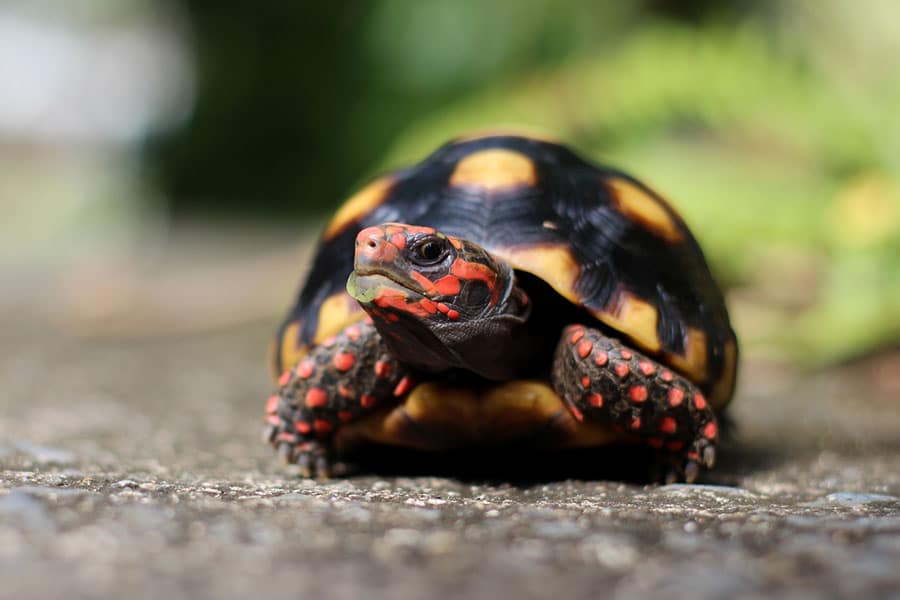
About: Red foots are native to northern South America, and are considered a medium sized tortoise, typically reaching 12-16 inches as adults. Red foots usually reach their full size when they are around 5-7 years old, although they can have a lifespan of over 50 years in captivity.
Red foot tortoises can be kept alone, as they are not especially social, but if you have enough space, they can be kept with multiple other red foot tortoises.
Lighting: When setting up lighting, you should put the heat lamp on a far end of an enclosure to create two distinct temperature zones. Red foot tortoises require a basking area (hottest point in enclosure) temperature of 90-95°F, and a warm area of around 80-90°F. The cool side of the tank should be around 75-80, and the nighttime temperature shouldn’t fall below 65°F.
A lot of reptiles can develop calcium deficiencies, and can make their shells go soft, which is why having a UVB light for a tortoise is so important. UVB bulbs also allow tortoises to produce Vitamin D3, which helps absorb calcium from their diet and can prevent diseases, and support their overall health.
Enclosure: Because red foot tortoises get so big, a minimum tank size for an adult is 8 feet long by 4 feet wide. Many people choose to use troughs or old bookshelves as an easy, inexpensive way to house a tortoise. Having an outdoor enclosure is also common, as long as it stays warm enough and has a cover to protect from predators.
Red foot tortoises like very humid environments of 70-90% humidity, so you’re going to want to use a substrate (anything used for bedding) that holds water well. Usually a mix of any reptile-safe soil, and coconut husk is best. You can also add moss to help maintain humidity.
Feeding and Watering: Red foot tortoises need a variety of different foods. Their diet should be about 60% leafy greens (red leafed lettuce, swiss chard, parsley), 15% vegetables (pumpkin, carrots, zucchini), 15% fruits (blueberries, strawberries), and 10% protein (earthworms, mealworms). To help keep strong shells and bones, sprinkle calcium on their salad 3-4 times a week.
Baby tortoises need to eat every day, whereas adults can eat 2-3 times a week.
Red Foot Tortoise Supplies Checklist
- Tank
- Screen lid
- Lid clamps
- Foliage
- Water bowl
- Thermometer
- Hydrometer
- Light fixture
- Heat bulb
- UVB
- Mister
- Substrate
- Moss
- Tongs
- Critter keeper
- Calcium
Have More Questions? Call the Experts at Moby Dick Pet Store at (248) 673-2520