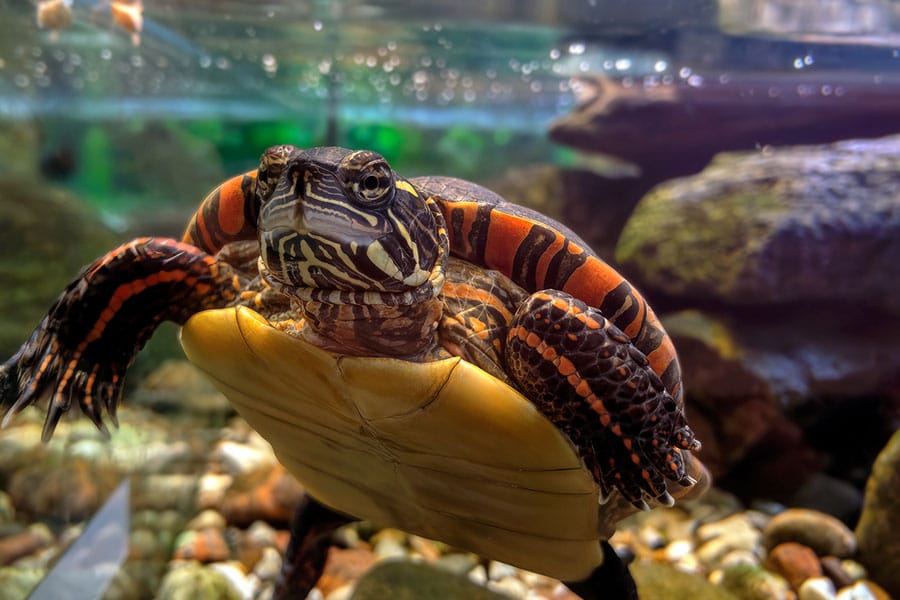
About: Freshwater turtles are native to many different areas of the world. Most turtles will live anywhere from 20-50+ years and range in size from about 6 inches to over a foot. Turtles, especially babies, have a risk of carrying salmonella, so it is very important to wash your hands when handling, or wear gloves.
Turtles are generally solitary animals and don’t need to be kept with others, although some turtles will tolerate being kept in pairs or small groups, depending on the species.
Lighting: A lot of reptiles can develop calcium deficiencies, which is why having a UVB light for a turtle is so important. UVB bulbs allow turtles to produce Vitamin D3, which helps absorb calcium from their diet and can prevent diseases, while supporting their overall health. It also will help keep their shell firm, and not having UVB can cause their shell to go soft, which can lead to illness or death. A UVB bulb only lasts for about 6 months to a year, and will need to be replaced, even if it’s still emitting light.
They will also require a heat light. Tank size and the air temperature can determine what wattage you need. Turtles need a dry daytime temperature of 78-82°F, and a basking temperature of 85-95°F. It’s okay to turn the heat light off at night, as long as the temperature doesn’t fall below 55॰ F, if it does, you may need a ceramic heat bulb, or another lightless heating option.
You will also need a water heater to help keep the temperature of the water around 75-80°F.
Tank: Most adult turtles will need about a 50-120 gallon tank, depending on the species. A good rule of thumb is to have at least 10 gallons of water for every inch of the length of the turtle.
There should be a basking dock for the turtle to climb out and dry off, as freshwater turtles are semi-aquatic. This helps them regulate their body temperature and prevent shell rot.
You will need a screen lid with clamps to keep it in place. You can set the lights directly on top of the lid.
Feeding and Water: Turtles are omnivores, so their diet usually consists of about 50% leafy greens (any freshwater plant, lettuce, or occasional fruits as a treat) 20% pellets and 30% protein (like insects, bloodworms or shrimp.)
It is important not to put any pet fish in with a turtle, even if the fish is big, because it can still get eaten or have its fins nipped.
Turtles can be very messy, so you’ll have to do a water change every week or every two weeks, and change the filter cartridge every month. When doing a water change, you should try to drain about 50% of the water in the tank.
You should never use just plain water from the tap when setting up a turtle aquarium. It should be about 50 percent purified water or RO (reverse osmosis) water, and 50 percent spring water, or dechlorinated tap water.
Supplies Checklist
- Tank
- Screen lid
- Lid clamps
- Foliage
- Thermometer
- Light fixture
- Heat bulb
- UVB
- Mister
- Substrate
- Dock
- Food
- Water heater
- Water thermometer
- Calcium
- Filter
- Filter cartridges
- Dechlorinator
- Tongs
Have More Questions? Call the Experts at Moby Dick Pet Store at (248) 673-2520